support@yorubalibrary.com
+2348073529208, 07038599574
In Yoruba oral tradition, performance is often drawn directly from lived experience. The community itself becomes the source of inspiration, and everyday events are re-shaped into structured songs, commentary, and rhythmic expression. Among such traditions is Bọ̀lọ̀jọ̀, a popular form of oral literature especially associated with the Ègbádò people.
Bọ̀lọ̀jọ̀ is a social performance tradition that depicts what is happening in the town at a given time. It is not tied to deities, masquerade festivals, or heroic mythology. Instead, it is grounded in daily human activity—relationships, behaviors, disputes, achievements, and public events. In this way, it serves as a cultural “live report” of society, transformed into music and satire.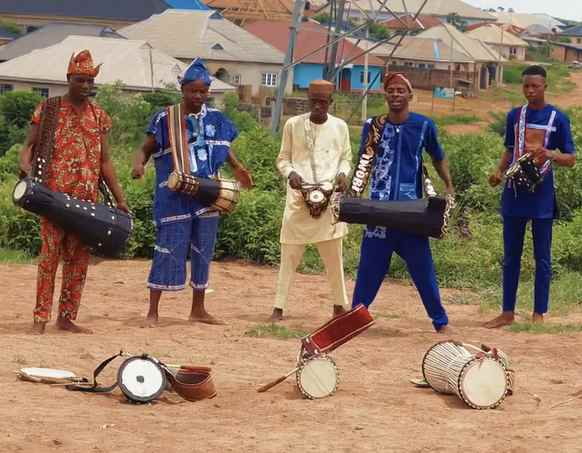 Unlike highly ritualized oral forms, Bọ̀lọ̀jọ̀ is flexible and widely accessible. It appears during major social gatherings such as naming ceremonies, traditional marriages, funerals, and communal celebrations. Wherever people gather, Bọ̀lọ̀jọ̀ can appear as a form of entertainment.
At its core, Bọ̀lọ̀jọ̀ is built on observation. Performers pay attention to what is happening in the community and convert it into structured performance. Because of this, it is often described as “the voice of the town,”.
Wait a bit... Do you know that understanding the Orishas requires more than surface knowledge?
Get a structured and comprehensive eBooks on Orisha Osun, Orisha Oro, Orisha Sango, Orisha Ogun, Orisha Obatala, and Orisha Esu, covering how they are deified, rituals, taboos, festivals, oriki and more. Available individually or in bundles
What Bọ̀lọ̀jọ̀ Represents in Yoruba Social Life
Bọ̀lọ̀jọ̀ is more than performance; it is a form of community storytelling through satire and rhythm. It shows how people behave, how society reacts, and how events are remembered. Unlike formal historical records, it does not rely on written documentation. Instead, it preserves its genre through repetition, song, and performance.
What makes Bọ̀lọ̀jọ̀ powerful is its ability to transform ordinary events into meaningful commentary. A small misunderstanding, a public incident, or even a widely discussed rumor can become material for performance. Once transformed into Bọ̀lọ̀jọ̀, the event is no longer just personal—it becomes communal knowledge.
This transformation ensures that behavior within the community is always under subtle observation. People are aware that their actions may become part of public performance, which encourages social awareness and accountability.
Difference Between Bọ̀lọ̀jọ̀ and È̩fẹ̀
Bọ̀lọ̀jọ̀ is often compared to È̩fẹ̀ because both use humor, satire, and storytelling to show society. However, there is a clear difference in context and function.
1) È̩fẹ̀ is closely linked to the Gèlèdé festival and its masquerade tradition.
2) Bọ̀lọ̀jọ̀ is not tied to any deity or festival structure. It is purely social and secular.
While È̩fẹ̀ operates within a ritual and festival framework, Bọ̀lọ̀jọ̀ exists in everyday gatherings. This makes it more flexible and widely used across different occasions.
Social Function: Turning Daily Life into Performance
The main function of Bọ̀lọ̀jọ̀ is to transform everyday experiences into shared cultural expression. It draws from:
• events in the town
• interpersonal relationships
• public behavior
• notable incidents
Bọ̀lọ̀jọ̀ does not merely repeat events; it interprets them. By exaggeration, humor, and poetic language, performers highlight the meaning behind actions. This makes the audience both entertained and reflective.
The Role of Performers in Bọ̀lọ̀jọ̀
Both men and women actively participate in Bọ̀lọ̀jọ̀ performance. This inclusiveness allows for a variety of voices and styles, making the tradition rich and dynamic. Performers are often skilled in:
• Yoruba poetic language
• improvisation
• rhythm and tone control
• storytelling and exaggeration
They must also be highly observant, as their material comes directly from real-life situations within the community.
Yoruba Herbs, Plants and Medicine Made Simple!
Spiritual knowledge is powerful—but when combined with herbal wisdom, it becomes complete. Check out Common Ailments and Their Natural Cures (preview here), Identification & Properties of Different Plants (see sample), Yoruba proverbs associated with different Herbs (see preview).
With these e-Books, you can treat illnesses naturally. Understand the proverbs behind plants/herbs. Identify plants, roots, barks with confidence.
Performance Context: Ceremonies and Social Gatherings
Bọ̀lọ̀jọ̀ is commonly performed during important social events such as:
1) Naming ceremonies
2) Traditional weddings
3) Funeral gatherings
4) Community celebrations
In these settings, it serves as entertainment while also showcasing the social atmosphere of the occasion. The performance often adapts to the specific event, making it relevant to the people present.
Example of Practical Rendition of Bọ̀lọ̀jọ̀
Find below the example of Bolojo when being rendered:
Oro kan sonu lowo asefe
Mo fe ki n wa fi to yin leti
A lowo pelomo ta lo jura won
A sa le binu segita, ko dowo
Omo ko sa se e fibinu bi
Se b'Oluwa lo n se tomo
A ko romo ra ni ssobu
Oluwa ni n mu un wa
A sa le binu segita ko dowo
Omo ko sa se e fibinu bi
Oluwa lo n se tomo
Oba Oke n be leyin olododo
Eni sooto,
Mo sebi a baa lorun, lojo o ba ya
Alawura n be leyin olododo
Eni sooto,
Mo sebi a baa lorun lojo o ba ya
Ipe ko ni si, dakun ko ni si
Feni ti o ba sododo
Elese kankan ko lorun
Oba loke Oba laye
Ejo n be lorun, asawi,
Omo owenewene.
Ese daye, obinrin ko mo nnkan
To ba doko tan, a maa powe
Bo ba boko ninu, a bere si wogi kiri
A leri leri, a ni: 'kin lo le se oko?
Iyen ni ohunn ale n wi pelu e nigbangba
A laya laya, a ni: "kin lo le so oko?"
Iyen ni ohun ale n wi pelu e nigbangba
E ko wede ayokodo?
Oro iyen loko maa n so
Benikan dasewo, kii moye to maa ni
A maa yanko sode bi irinwo
N o ba yin wi o, gbogbo obinrin
Gbogbo yin ko
Gbogbo yin ko lo n rinde oganjo
Gbogbo hin ko lo n rinde okunkun
Oju asewo ni n foro naa ye
Eni o le ye ko ye
Asewo ni n soro fun
Eni o le gbo ko gbo
Saa laa ni; ta lo laye?
In performance, the lead performer introduces a familiar community situation, re-shaping it into humorous and rhythmic storytelling. The chorus responds with repetition and musical rhythm, while the audience reacts with laughter and recognition. The message is understood through shared experience rather than direct explanation.
Content Source: Life as the Main Script
The strength of Bọ̀lọ̀jọ̀ lies in its content source—life itself. Unlike traditions that rely on mythology or sacred texts, Bọ̀lọ̀jọ̀ is built on what people see and experience daily. This includes:
1) gossip and public discussion
2) observed behavior in the community
3) recent incidents or disputes
4) notable achievements or failures
Structure and Style of Performance
Bọ̀lọ̀jọ̀ is performed with rhythm, repetition, and musical flow. The language is expressive and often humorous, using Yoruba tonal patterns to enhance meaning. Key stylistic features include:
• rhythmic chanting
• call-and-response patterns
• repetition for emphasis
• exaggeration for comedic effect
Cultural Role: Entertainment with Focus
While Bọ̀lọ̀jọ̀ is entertaining, it also serves a cultural function. It encourages thinking on behavior without direct confrontation. By presenting real-life situations in a humorous format, it allows people to see themselves in the performance without feeling attacked. This balance is what makes Bọ̀lọ̀jọ̀ culturally valuable.
The Continuity
Bọ̀lọ̀jọ̀ remains an important part of Yoruba social life, especially among the Ègbádò people. It preserves community memory, strengthens social awareness, and provides a platform for shared thoughtfulness.
The composition and rendition of Òkú-Pípè, a solem…
Learn about È̩gẹ̀, a Yoruba oral praise tradition …
CONNECT WITH US: