support@yorubalibrary.com
+2348073529208, 07038599574
In Yoruba cosmology, Ògún is regarded as the primal force of iron, war, and transformation. His power is not limited to personal attributes or human affairs; he is also a divine facilitator. Oral traditions consistently depict Ògún as the path-clearing Orisha, whose mastery of iron and strength allowed other Orishas to enter the world and carry out their functions. Without Ògún’s intervention, the divine order of the cosmos might have been obstructed, as forests were dense, rivers unpredictable, and human settlement often precarious.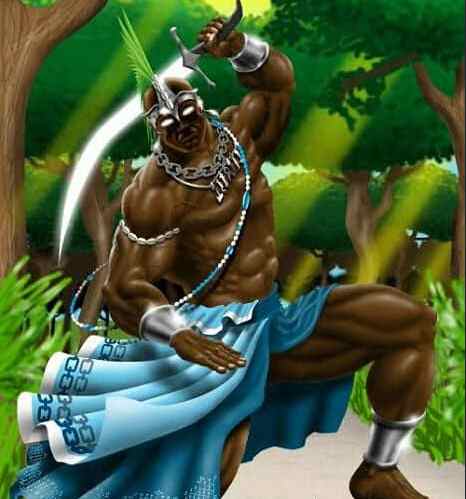 This concept lies in Yoruba mythology, where narratives describe Ògún clearing roads, cutting through dense vegetation, and forging literal and spiritual pathways for other deities. In this role, he is both a warrior and a pioneer, a figure whose actions enable civilization and divine governance to flourish. Through this mythological lens, iron is not just a material but a cosmic instrument.
The story of Ògún as pathmaker shows several layers: spiritual, ecological, and societal. It explains his indispensable presence in rituals, his association with justice and oath-taking, and his connection to tools and weapons. It also highlights his unique place among Orishas as a facilitator of divine work, bridging the gap between primordial chaos and structured order.
Ògún as the First Path-Clearing Orisha
According to Yoruba oral tradition, the earth was once covered in impenetrable forests, rivers, and wilderness. Other Orishas, including Ṣàngó, Ọya, and Ọbatala, faced physical and metaphysical obstacles in their mission to establish order and justice among humans. Ògún, armed with iron tools, cut through these barriers, forging the first roads and pathways.
This act was not merely practical; it was unique and evident. Each cleared path represented the manifestation of divine will in the material world. Iron, in this sense, was a conduit of cosmic authority. The clearing of roads enabled other Orishas to move freely, deliver justice, and teach humans skills such as agriculture, law, and ritual performance.
Wait a bit... Do you know that understanding the Orishas requires more than surface knowledge?
Get a structured and comprehensive eBooks on Orisha Osun, Orisha Oro, Orisha Sango, Orisha Ogun, Orisha Obatala, and Orisha Esu, covering how they are deified, rituals, taboos, festivals, oriki and more. Available individually or in bundles
Facilitating the Arrival of Other Orishas
One of the most celebrated myths tells how Ògún cleared the path for Ṣàngó, the god of thunder and lightning, to descend to the earth. Dense forests and dangerous terrains had previously hindered the arrival of powerful Orishas. Ògún’s iron machetes sliced through the thicket, creating safe corridors.
Similarly, the Orisha Ọya, associated with wind, storms, and change, needed open spaces to demonstrate her powers. Ògún’s intervention represent preparation and support, ensuring that the cosmic and human orders could function harmoniously.
These narratives highlight a principle in Yoruba theology: divine forces operate interdependently. Even a god as powerful as Ṣàngó required the groundwork provided by Ògún. His pioneering role underscores his seniority and indispensability in the Yoruba pantheon.
Ògún’s Tools as Cosmic Instruments
Ògún’s ability to create pathways relied on iron, both as material and symbol. His tools—machetes, knives, and axes—were imbued with spiritual energy. Each strike did not just alter the physical environment; it transformed the metaphysical landscape, allowing other Orishas to exercise their powers safely and effectively.
This function of tools connects directly to human activities. Just as Ògún clears paths for Orishas, humans rely on iron tools to cultivate land, build homes, and navigate forests. Rituals dedicated to Ògún often include offerings of iron objects, depicting recognition of his role as facilitator and protector.
Yoruba Herbs, Plants and Medicine Made Simple!
Spiritual knowledge is powerful—but when combined with herbal wisdom, it becomes complete. Check out Common Ailments and Their Natural Cures (preview here), Identification & Properties of Different Plants (see sample), Yoruba proverbs associated with different Herbs (see preview).
With these e-Books, you can treat illnesses naturally. Understand the proverbs behind plants/herbs. Identify plants, roots, barks with confidence.
Spiritual Implications of Path-Clearing
Theologically, Ògún’s path-clearing represents the unblocking of spiritual, moral, and social pathways. Just as he clears physical forests, he removes obstacles to justice, wisdom, and prosperity. Devotees believe that invoking Ògún can remove barriers in personal life, business, or ritual practice.
In ceremonial practice, paths to shrines are often ritually cleared, invoking Ògún to remove obstacles before festivals, initiations, or important communal decisions. These acts reinforce his authority, connecting cosmic myth to lived human experience.
Conclusion
Ògún’s role as pathmaker illustrates his centrality in Yoruba religion. By creating physical and spiritual pathways, he enables the arrival, action, and influence of other Orishas. His mastery of iron, combined with his strength, vigilance, and moral authority, positions him as a cosmic facilitator, a deity whose labor ensures order, justice, and access for all other divine forces.
Learn the general taboos of Orisha Oko in Yoruba c…

Check out the common items used in worshiping Oris…
CONNECT WITH US: