support@yorubalibrary.com
+2348073529208, 07038599574
Sango was a powerful and influential king of the Oyo Empire, known for his mastery over thunder, lightning, and fire. His exceptional leadership, military prowess, and spiritual strength earned him great respect during his lifetime. However, his mortal life ended amid stories of fierce temper and uncontrolled power.
After his death, Sango was deified and became an Orisha, a revered spirit in Yoruba religion. This transformation recognized him as a divine force associated with thunder, justice, and strength, elevating him beyond his earthly role. His worship spread widely, extending into various African diaspora religions where he continues to be honored.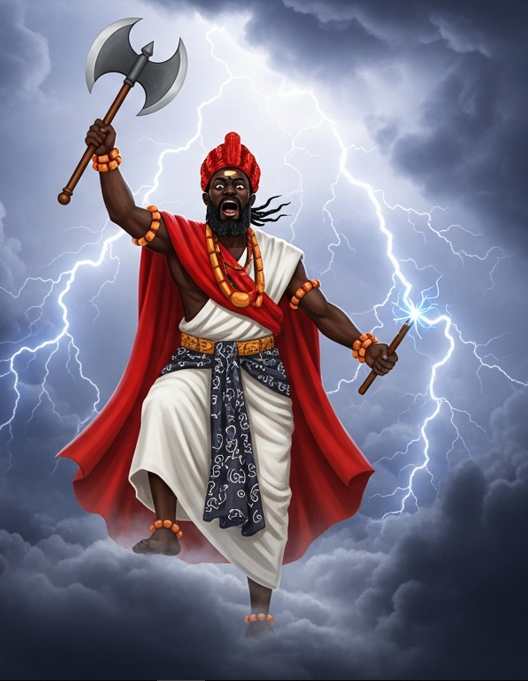 Sango’s rise from king to Orisha represents a direct link between human experience and spiritual authority, blending history with mythology. His enduring presence in rituals and beliefs illustrates how a historical figure can transcend mortality to become a lasting symbol of power and justice.
Historical Background of Sango
Sango is planted firmly in Yoruba cultural history and religious belief. His identity blends elements of actual rulership and spiritual power linked to natural forces. The significance of his legacy extends well beyond his earthly reign, showing connections to leadership.
Sango is traditionally recognized as a powerful figure within Yoruba mythology. He is often depicted as an Orisha, a divine spirit embodying thunder, lightning, fire, and justice. These elements underscore his association with raw energy and authority.
He was not originally a god but a mortal ruler whose life and traits inspired spiritual reverence. Stories emphasize his fearless nature and command over the elements, which elevated his status after death. The mythological narrative blends historic facts and symbolic meaning, elevating Sango from a legendary king to a deity who governs storms and justice.
Sango's Path to Becoming an Orisha
Sango's transformation from a mortal king to a revered Orisha is marked by his exceptional leadership, pivotal moments in his reign, and the mysterious circumstances surrounding his death. These elements collectively explain his enduring power and spiritual significance.
Sango was a formidable ruler and the third/fourth Alaafin (king) of the Oyo Empire. Known for his strength and commanding presence, he wielded authority through both military might and charismatic leadership. His control over thunder and lightning became symbolic of his power.
He was not just a political leader but also combined spiritual and judicial roles. His ability to inspire loyalty and lead armies to victory solidified his status among his people. This blend of earthly rule and supernatural capability set the foundation for his later deification.
Wait a bit... Do you know that understanding the Orishas requires more than surface knowledge?
Get a structured and comprehensive eBooks on Orisha Osun, Orisha Oro, Orisha Sango, Orisha Ogun, Orisha Obatala, and Orisha Esu, covering how they are deified, rituals, taboos, festivals, oriki and more. Available individually or in bundles
Transformation and Deification
Sango's shift from a mortal king to a revered Orisha involved both legendary narratives and cultural affirmation. This change brought new divine powers and established his lasting spiritual role among the Yoruba.
According to Yoruba mythology, Sango's transformation began after his death under tragic circumstances. It is said that after he died, his followers witnessed supernatural events linked to thunder and lightning, which were seen as signs of his continued presence.
Legends describe how Sango's spirit merged with the forces of nature. His ability to summon thunder and lightning in life was interpreted as proof that he transcended mortality to become a divine entity governing these elements.
These stories played an essential role in cementing his godly status, turning him from a historical figure into a mythic symbol of power and justice.
Sacred Objects and Symbols
Several objects and symbols are closely tied to Sango and his worship. The double-headed axe (also known as oshe or ose) is the most prominent symbol. It represents thunder and the power to balance opposing forces, linking Sango’s authority directly to his elemental control.
The color red is also significant, symbolizing fire, passion, and vitality. Worshippers wear red during rituals to invoke his favor and presence. Additionally, the Bata drums are essential in ceremonies, producing rhythms that connect followers to Sango's dynamic energy and invoke his spirit through dance.
Sacrificial offerings typically include items associated with fire and strength, further emphasizing his elemental and authoritative nature. These symbols and objects define the visual and ritualistic landscape of his veneration.
Yoruba Herbs, Plants and Medicine Made Simple!
Spiritual knowledge is powerful—but when combined with herbal wisdom, it becomes complete. Check out Common Ailments and Their Natural Cures (preview here), Identification & Properties of Different Plants (see sample), Yoruba proverbs associated with different Herbs (see preview).
With these e-Books, you can treat illnesses naturally. Understand the proverbs behind plants/herbs. Identify plants, roots, barks with confidence.
Legacy of Sango as an Orisha
Sango’s legacy extends well beyond his historical role as a king. His transformation into an Orisha elevated him to a symbol of power, justice, and spiritual authority. This legacy is preserved through religious practice and cultural celebrations that emphasize his elemental forces and leadership.
Festivals and Rituals Dedicated to Sango
Sango’s followers celebrate him through vibrant festivals, particularly the annual Sango festival in Yoruba regions. These events feature drumming, dancing, and sacrifices aimed at honoring his fiery spirit. The Bata drum plays a central role, symbolizing Sango’s thunderous energy.
Ritual offerings often include red items, ram, bitter cola (orogbo), and fire, emphasizing his connection to lightning and heat. These ceremonies serve not only as acts of devotion but also as cultural affirmations of identity and continuity. The rituals ensure Sango’s legacy remains a living force within Yoruba spirituality and beyond.
Learn the general taboos of Orisha Oko in Yoruba c…

Check out the common items used in worshiping Oris…
CONNECT WITH US: