support@yorubalibrary.com
+2348073529208, 07038599574
In Yoruba cosmology, each Òrìṣà has specific powers, responsibilities, and spheres of influence. While all Òrìṣà are important, Obatala is frequently regarded as the apex—holding a primacy that distinguishes him from other divine beings. This status is not arbitrary; it stems from his cosmological role, ethical authority, creative power, and moral integrity.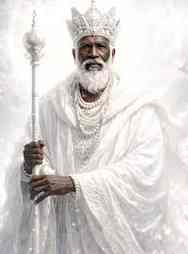 Obàtálá’s supremacy is in multiple dimensions: metaphysical, ethical, and social. Unlike deities whose power is displayed through force, spectacle, or martial prowess, Obàtálá’s authority is subtle yet absolute. His primacy showcases Yoruba understanding of order, creation, and leadership.
Cosmological Primacy: Shaper of Humanity
The foundational reason Obàtálá is considered apex lies in his creative role. According to Yoruba mythology, he is the sculptor of human beings, molding them from clay under the mandate of Olódùmarè, the Supreme God. This act of creation places him in a unique position: he is the origin of human form, the guarantor of life’s material expression, and a bridge between divine authority and human existence.
While other Òrìṣà govern natural phenomena, war, wealth, or fertility, Obàtálá governs the very template of humanity. Every human being carries his mark in form and dignity, regardless of lineage or social status. This foundational role positions him above others because creation precedes specialization.
Ethical Authority and Moral Leadership
Obàtálá’s supremacy is showcased by his embodiment of ethics. He represents purity, patience, and restraint—qualities essential for moral governance. In contrast to deities like Ṣàngó, whose justice may be explosive, or Ògún, whose authority comes through force, Obàtálá’s power lies in steady judgment and moral clarity.
He is known as the arbiter among Òrìṣà. Conflicts that cannot be resolved by others may be brought before him. His “slow but sure” judgment is trusted to be impartial, precise, and ultimate. The apex status is therefore both cosmic and judicial: he is the moral compass for divine and human affairs alike.
Symbolism of Whiteness and Purity
Obàtálá’s whiteness represents more than aesthetic choice—it passes authority, moral integrity, and spiritual clarity. In Yoruba thought, white is associated with light, calm, and cosmic order. The visible markers of his whiteness distinguish him in ritual and theology, signaling that he occupies a superior moral and spiritual tier.
Wait a bit... Do you know that understanding the Orishas requires more than surface knowledge?
Get a structured and comprehensive eBooks on Orisha Osun, Orisha Oro, Orisha Sango, Orisha Ogun, Orisha Obatala, and Orisha Esu, covering how they are deified, rituals, taboos, festivals, oriki and more. Available individually or in bundles
Mediator Between Supreme God and Other Òrìṣà
Obàtálá also serves as a crucial intermediary between humans, other Òrìṣà, and Olódùmarè. While Òrìṣà like Èṣù deliver messages and enforce cosmic balance, Obàtálá carries ultimate responsibility for the moral ordering of creation. His apex status is represents by this central mediating role: he oversees the conduct of both humans and other divine agents. In some myths, disputes among Òrìṣà themselves are resolved by Obàtálá. He sets boundaries, maintains order, and ensures that divine law goes with cosmic balance.
Patronage of the Vulnerable
Another reason for Obàtálá’s primacy is his association with marginalized and sacred groups. Albinism, physical deformity, and other vulnerable conditions are traditionally considered under his protection. This emphasizes that his authority is not only cosmic but moral: he safeguards those whom society often neglects.
Influence in Ritual and Worship
Obàtálá’s rituals shows his supreme position. Devotees approach him first in ceremonial hierarchies. His offerings emphasize purity and care, depicting respect for foundational authority. He sets the tone for worship, influencing how other Òrìṣà are approached and honored.
Yoruba Herbs, Plants and Medicine Made Simple!
Spiritual knowledge is powerful—but when combined with herbal wisdom, it becomes complete. Check out Common Ailments and Their Natural Cures (preview here), Identification & Properties of Different Plants (see sample), Yoruba proverbs associated with different Herbs (see preview).
With these e-Books, you can treat illnesses naturally. Understand the proverbs behind plants/herbs. Identify plants, roots, barks with confidence.
Apex as a Model of Leadership
Obàtálá’s apex status also functions as a model for human governance and personal conduct. Leaders are taught that patience, clarity, moral consistency, and protective responsibility are the hallmarks of legitimate authority. In this way, his primacy is not merely theological but socially instructive, bridging divine and human order.
Conclusion:
Obàtálá is considered apex among the Òrìṣà for several interconnected reasons. In essence, Obàtálá’s apex status is not about raw power, but about primacy in creation, morality, protection, and cosmic governance. Other Òrìṣà excel in specific domains, but Obàtálá integrates foundational, ethical, and spiritual authority, making him the supreme figure in Yoruba cosmology.
Learn the general taboos of Orisha Oko in Yoruba c…

Check out the common items used in worshiping Oris…
CONNECT WITH US: