support@yorubalibrary.com
+2348073529208, 07038599574
In Yorùbá religious life, location defines object. Sacred space is never random. Where a shrine is placed communicates theological understanding and social function. Among the Òrìṣà, Èsù stands out for the distinctive positioning of his shrines—at compound gates, along roadsides, at crossroads, and within market entrances. These are not accidental placements. They showcased his role as guardian, mediator, and regulator of human interaction. To an outside observer, a small shrine at a roadside corner may appear simple or even unnoticed. Yet within Yorùbá belief, that space is strategic. It marks a boundary between one state and another—inside and outside, movement and rest, intention and consequence. Èsù governs such thresholds.
Èsù as Guardian of Thresholds
Èsù is the divine messenger, enforcer of sacrifice, and regulator of consequence. Above all, he is the guardian of passages. He controls entry and exit, communication and blockage, opportunity and restriction.
In ritual practice, no offering reaches another Òrìṣà without first passing through him. This spiritual function is mirrored physically in the placement of his shrines at points of entry and movement. A gate is not merely a structure. It is a decision point. One either enters or remains outside. Èsù presides over that moment of transition.
Why Gates?
1. Protection of the Household
In traditional Yorùbá compounds, the gate marks the boundary between family space and the outside world. Placing Èsù at the gate establishes spiritual oversight at that boundary. He guards against harmful forces and monitors intentions of those entering.
2. Regulation of Social Exchange
Visitors, traders, strangers, and neighbors all pass through the gate. By situating Èsù there, the household acknowledges that all interactions fall under moral supervision.
3. Symbol of Authority
The gate is a controlled opening. It shows order and structure. Èsù’s presence at this point reinforces his administrative role within spiritual hierarchy.
Why Roadsides and Crossroads?
1. Crossroads as Points of Choice
Crossroads depicts decision-making. One must choose a direction. In Yorùbá thought, decisions carry consequences. Èsù governs that principle of cause and effect. By placing his shrine at crossroads, the community acknowledges his oversight of life’s turning points.
2. Roads as Channels of Movement
Roads connect communities. They carry travelers, trade, news, and opportunity. Movement requires guidance and protection. Èsù, as mediator and communicator, aligns naturally with these pathways.
3. Monitoring Public Space
A roadside shrine extends his guardianship beyond private households into communal territory. It affirms that moral accountability applies not only at home but in public life.
Why Markets?
Markets hold central importance in Yorùbá society. They are spaces of commerce, negotiation, and social interaction. Money changes hands. Agreements are made. Competition and cooperation coexist. Placing Èsù within or near market entrances shows several principles:
• He oversees fairness in exchange.
• He regulates honesty in trade.
• He monitors speech and agreement.
Markets are environments where intention meets action. Èsù’s presence reminds participants that deceit and integrity both produce outcomes.
Wait a bit... Do you know that understanding the Orishas requires more than surface knowledge?
Get a structured and comprehensive eBooks on Orisha Osun, Orisha Oro, Orisha Sango, Orisha Ogun, Orisha Obatala, and Orisha Esu, covering how they are deified, rituals, taboos, festivals, oriki and more. Available individually or in bundles
The Concept of Liminal Space
Anthropologically, gates, crossroads, and markets are examples of liminal spaces—areas that exist between defined states. Yorùbá cosmology recognizes these spaces as spiritually sensitive. Èsù thrives at boundaries:
• Between sacred and ordinary space
• Between speech and silence
• Between intention and result
Structure of the Shrine
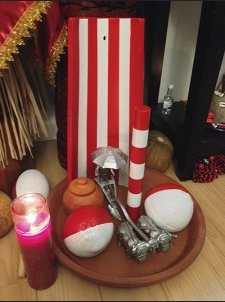
Èsù’s shrines may include laterite stone (Yangí), molded earth forms, cowries, or ritual markings in red and black. The simplicity of many roadside shrines does not reduce their effectiveness. Their power lies in placement and recognition. Often positioned slightly to the side of the main path, they remain visible yet unobtrusive
Addressing Misunderstandings
Colonial observers sometimes interpreted these roadside shrines as evidence of fear or superstition. Such interpretations ignored the structured logic behind their placement. Èsù’s positioning at gates and markets shows governance, not threat. He enforces order within movement. His shrine marks responsibility, not danger.
Yoruba Herbs, Plants and Medicine Made Simple!
Spiritual knowledge is powerful—but when combined with herbal wisdom, it becomes complete. Check out Common Ailments and Their Natural Cures (preview here), Identification & Properties of Different Plants (see sample), Yoruba proverbs associated with different Herbs (see preview).
With these e-Books, you can treat illnesses naturally. Understand the proverbs behind plants/herbs. Identify plants, roots, barks with confidence.
Social and Moral Function
The visibility of Èsù’s shrine reinforces communal awareness:
• Actions have consequences.
• Entry requires respect.
• Agreements must be honored.
• Speech carries weight.
Conclusion
Èsù’s physical shrines are placed at gates, roadsides, crossroads, and markets because these are points of transition and decision. As guardian of thresholds and mediator of consequence, his presence at such locations goes perfectly with his cosmic role.
The gate represents entry. The road represents movement. The market represents exchange. At each of these spaces, choice operates—and where choice operates, consequence follows. Èsù stands at that intersection, ensuring balance, accountability, and spiritual order.

Learn the general taboos of Orisha Oko in Yoruba c…
Check out the common items used in worshiping Oris…
CONNECT WITH US: