support@yorubalibrary.com
+2348073529208, 07038599574
One Yoruba sayings goes thus: "Oniyangi maba t'emi je, epo ni mo ru". In Yorùbá religious thought, every Òrìṣà has physical symbols that make their presence visible and tangible. For some, it may be carved wood, sacred iron, river water, or a clay figure. For Èsù, however, one of the most striking representations is a simple piece of laterite stone known as Yangí. To an outsider, it may look ordinary. To the devotee, it is a unique sign of divine authority.
The use of Yangí is not accidental, it is a theological understanding. In Yorùbá cosmology, matter and spirit are not separate worlds; the visible and invisible constantly interact. The laterite stone becomes a point of contact between human beings and the spiritual force of Èsù, who stands at the crossroads of communication, choice, and consequence.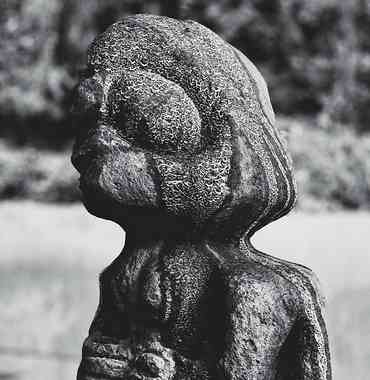 Understanding why Èsù is worshipped in a laterite stone requires clarity about who Èsù is, what Yangí represents, and how sacred objects function in Yorùbá religion. When these elements are examined together, the meaning becomes clear and comprehensive.
Who Is Èsù in Yorùbá Cosmology?
Èsù occupies a unique position among the Òrìṣà. He is the divine messenger, the enforcer of sacrifice, the guardian of crossroads, and the one who ensures that moral laws produce appropriate consequences. No offering reaches any Òrìṣà without first passing through Èsù.
He is sometimes misunderstood as a symbol of chaos or evil (idaru-dapo), largely due to colonial misinterpretations. In reality, Èsù represents balance, justice, and the unpredictable dimension of life. He tests sincerity. He exposes hypocrisy. He rewards integrity and correct sacrifice.
Because of his role as a mediator between humans and the spiritual realm, his shrine must shows stability, presence, and grounded authority. This is where the Yangí stone becomes important.
What Is Yangí?
Yangí is a naturally occurring laterite stone, reddish in color, commonly found in Yorùbá land. Laterite is formed through intense weathering of tropical soil, producing a dense, iron-rich rock. In traditional understanding, this stone is not just geological material; it has spiritual potency.
Unlike carved images, Yangí is often left in its natural form. It is not shaped into a human figure. This is important. Èsù is not limited to anthropomorphic representation. His essence is force, movement, and presence rather than physical likeness. The redness of laterite is also important. Red in Yorùbá thought signifies power, vitality, and active energy. These qualities align closely with the dynamic character of Èsù.
Wait a bit... Do you know that understanding the Orishas requires more than surface knowledge?
Get a structured and comprehensive eBooks on Orisha Osun, Orisha Oro, Orisha Sango, Orisha Ogun, Orisha Obatala, and Orisha Esu, covering how they are deified, rituals, taboos, festivals, oriki and more. Available individually or in bundles
Why a Piece of Laterite Rock?
1. Symbol of Earthly Authority
Èsù operates at the boundary between the spiritual and earthly realms. Laterite comes directly from the earth. It represents groundedness and immediacy. By using earth-derived stone, worshippers acknowledge Èsù’s closeness to human affairs.
2. Durability and Permanence
Laterite is strong and resistant. Èsù’s function in maintaining cosmic order is constant and unchanging. The stone shows firmness, reliability, and endurance.
3. Natural Power (Àṣẹ)
In Yorùbá belief, certain natural materials carry concentrated àṣẹ (spiritual authority). Laterite, formed through long natural processes, comprises the accumulated force. Yangí is therefore not chosen randomly; it is recognized as a vessel capable of holding spiritual energy.
4. Simplicity Over Ornamentation
Unlike some Òrìṣà whose shrines may involve elaborate carvings, Èsù’s Yangí emphasizes raw presence. This reinforces the idea that divine power does not depend on artistic beauty. Authority can dwell in what appears simple.
The Theological Meaning of Yangí
The Yangí stone teaches important principles about Yorùbá spirituality:
• The sacred can inhabit the ordinary.
• Spiritual force is not always expressed through human-like images.
• Nature itself is a carrier of divine authority.
When devotees pour libation, offer sacrifice, or speak prayers before Yangí, they are not worshipping stone. They are addressing the spiritual presence of Èsù that is invoked and established there. This distinction is crucial. The stone is a medium, not the ultimate object of devotion.
Yangí in Ritual Practice
In traditional compounds, Yangí may be placed at the entrance of a home or shrine space. This placement depicts Èsù’s role as gatekeeper. He stands at thresholds—between inside and outside, sacred and ordinary space, intention and outcome.
Offerings such as palm oil, kola nut, or other ritual items may be presented to Yangí. These acts are not a mere gestures alone; they are practical engagements within a spiritual system that emphasizes reciprocity and accountability. In larger temples, Yangí may be incorporated into more complex shrine structures. Yet even in such settings, the stone remains central.
Yoruba Herbs, Plants and Medicine Made Simple!
Spiritual knowledge is powerful—but when combined with herbal wisdom, it becomes complete. Check out Common Ailments and Their Natural Cures (preview here), Identification & Properties of Different Plants (see sample), Yoruba proverbs associated with different Herbs (see preview).
With these e-Books, you can treat illnesses naturally. Understand the proverbs behind plants/herbs. Identify plants, roots, barks with confidence.
Correcting Misconceptions
Colonial and missionary interpretations often misrepresented Èsù, equating him with foreign concepts of evil. This misunderstanding extended to the Yangí stone, which was dismissed as idol worship.
However, within Yorùbá theology, the stone is comparable to symbols in many world religions. Just as a cross, relic, or sacred book represents divine connection in other traditions, Yangí represents the presence and authority of Èsù. The difference lies not in superstition but in cultural expression.
Conclusion
The Yangí stone is more than a piece of laterite. It is a carefully chosen medium that represents the character, authority, and function of Èsù in Yorùbá cosmology. Its earth-derived nature speaks of grounded power. Its durability shows constancy. Its redness signals active spiritual force.
Learn the general taboos of Orisha Oko in Yoruba c…

Check out the common items used in worshiping Oris…
CONNECT WITH US: