support@yorubalibrary.com
+2348073529208, 07038599574
Among all sacred objects tied to Sàngó, none captures his authority as clearly as Òṣè, the double-headed axe. Its appearance alone carries weight: two blades facing opposite sides, balanced on a single handle, lifted high by priests, dancers, and the Èlégún Sàngó during possession.
People often know the symbol, but very few understand the full depth behind it — why Sàngó uses this axe, what the double-head signifies, how it functions spiritually, and how it became one of the most recognized emblems in Yorùbá traditional religion. Let's see why the Oshe Sango bears such power in Yoruba mythology...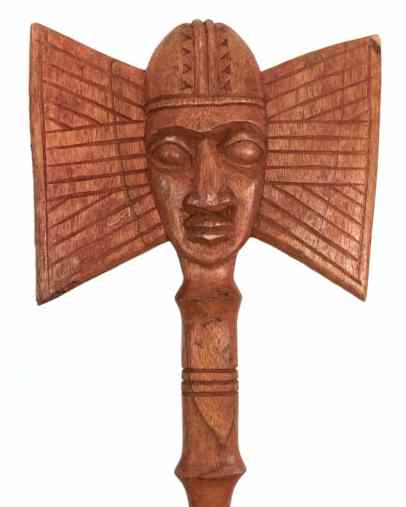
What Is Òṣè Sàngó?
Òṣè is Sàngó’s double-headed axe, carved from wood or metal, and used in shrines, festivals, dances, and possession ceremonies. It represents:
1) Authority backed by discipline
2) Power without confusion
3) The balance between justice and fairness
4) Sàngó’s identity as a king who must act in both firm and measured ways
Why Sàngó Uses Òṣè
The axe carries layers of meaning connected to Sàngó’s nature as both a historical king and a spiritual force.
1. A Symbol of Command
A king in ancient Oyo walked with visible signs of authority — staffs, insignias, and personal emblems. Whenever the axe appears, it signals the presence of a leader who cannot be ignored.
For Sàngó, the axe served as the clearest reminder of:
• His right to speak
• His right to judge
• His responsibility to maintain order
2. The Axe Represents Swift Consequence
Sàngó is known for quick response to wrong-doing. The double-head of the axe suggests that consequences can fall from any direction. It stands for:
a) Direct action
b) Immediate justice
c) The truth that no wrong escapes notice
d) The axe does not wait or hesitate.
3) Representation of His Royal Bearing
Oríkì often describe Sàngó as a king with great presence, always composed, always ready. The axe in his hand reinforces this picture: a king who stands tall with confidence, yet acts only after proper thought.
Wait a bit... Do you know that understanding the Orishas requires more than surface knowledge?
Get a structured and comprehensive eBooks on Orisha Osun, Orisha Oro, Orisha Sango, Orisha Ogun, Orisha Obatala, and Orisha Esu, covering how they are deified, rituals, taboos, festivals, oriki and more. Available individually or in bundles
Meaning of the Double Head
The two blades of Òṣè are among its most important features. They stand for:
1. Justice in Two Directions
2. Strength and Restraint
3. The Seen and Unseen
4. Two Eyes of a King
How Òṣè Is Used in Sàngó Worship
1. Carried by Èlégún Sàngó
During possession, the dancer holds the axe as the physical sign that Sàngó has arrived. The movement of the axe shows divine presence, and the dancer’s gestures often follow the rhythm of the drum known as Bàtá or Dùndún.
2. Present in Shrines
Inside Sàngó shrines, Òṣè is placed upright, often next to Edun Ara. Its position indicates readiness — Sàngó is always alert.
3. Used for Blessings and Declarations
Priests may raise the axe during prayers of protection, success, and judgement. It acts as a seal that words spoken in truth will stand.
4. Symbol of Victory in Festivals
During annual festivals, the axe is displayed to show Sàngó’s victory over false accusations and enemies. It reminds the community that truth eventually triumphs (Otito a b'ori).
Power Attached to Òṣè
The power of the axe is not merely physical; it is spiritual authority shaped by centuries of collective belief.
1. Power of Truth
Where the axe stands, falsehood cannot stand with it. Devotees believe Òṣè clears confusion and reveals sincerity.
2. Power of Courage
To hold the axe is to call upon bravery. This is why some devotees pray with miniature versions for confidence in difficult decisions.
3. Power of Protection
Sàngó protects the innocent. The axe symbolizes the shield he raises over those who seek fairness.
Yoruba Herbs, Plants and Medicine Made Simple!
Spiritual knowledge is powerful—but when combined with herbal wisdom, it becomes complete. Check out Common Ailments and Their Natural Cures (preview here), Identification & Properties of Different Plants (see sample), Yoruba proverbs associated with different Herbs (see preview).
With these e-Books, you can treat illnesses naturally. Understand the proverbs behind plants/herbs. Identify plants, roots, barks with confidence.
Modern Understanding
Today, Òṣè still appears in festivals, artistic carvings, cultural symbols, community theatre, and in the hands of modern-day Sàngó devotees.
Some keep miniature axes as reminders of:
• Personal strength
• Balanced judgement
• Steady confidence
• The courage to confront injustice
Òṣè remains relevant because people still admire the same qualities Sàngó represented — firmness, self-control, and clarity.
Conclusion
Sàngó’s axe, Òṣè, is not just a ritual object. It is a complete message: Power must be balanced. Leadership must be just. Action must be deliberate.
Learn the general taboos of Orisha Oko in Yoruba c…

Check out the common items used in worshiping Oris…
CONNECT WITH US: