support@yorubalibrary.com
+2348073529208, 07038599574
Music is at the heart of Yoruba spirituality, and no Orisha demonstrates this more vividly than Ṣàngó, the deity of thunder, lightning, fire, and kingship. His worship is inseparable from rhythms, drums, and chants, which are not merely artistic expressions—they are spiritual tools. Through music, devotees communicate with Ṣàngó, invite his presence, and align themselves with his energy.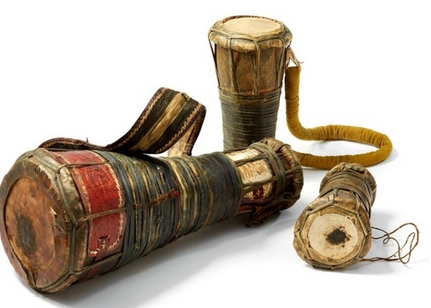 In Yoruba belief, sound carries power. The deep rumble of drums mirrors thunder, sharp drum patterns echo lightning, and the chants invoke the moral authority, courage, and fire that Ṣàngó embodies. Each instrument in his worship has a specific role, contributing not only to the ceremony’s aesthetic richness but also to its spiritual efficacy. Understanding these instruments offers insight into Yoruba cosmology, philosophy, and the dynamic way humans connect with divine power.
Bàtá Drums: The Voice of Ṣàngó
The bàtá drum is perhaps the most iconic instrument in Ṣàngó worship. Its three-part structure produces complex rhythms that emulate the sound of thunder and rolling storms, directly linking the musical experience to the Orisha’s elemental power.
1) Symbolic Function:
The drum is considered Ṣàngó’s voice. Its deep, commanding tone announces his presence and communicates his moods, from warning and judgment to celebration and protection.
2) Ritual Usage:
Bàtá drums are used in ceremonies, festivals, and possession rites. Drummers skilled in Ṣàngó rhythms can call the Orisha into dance, guiding devotees through trance states and spiritual encounters.
3) Cultural Significance:
Beyond the shrine, bàtá drums transmit oral history, praise songs (oríkì), and moral teachings about courage, leadership, and justice.
The drum’s rhythms are not random; each pattern is a coded message showing Ṣàngó’s authority, strength, and temperament. Learning these rhythms is considered both an artistic and spiritual discipline.
Wait a bit... Do you know that understanding the Orishas requires more than surface knowledge?
Get a structured and comprehensive eBooks on Orisha Osun, Orisha Oro, Orisha Sango, Orisha Ogun, Orisha Obatala, and Orisha Esu, covering how they are deified, rituals, taboos, festivals, oriki and more. Available individually or in bundles
Gángan (Talking Drum): Dialogue with the Orisha
The gángan, or talking drum, complements the bàtá by adding tonal dialogue to ceremonies. It is capable of mimicking human speech patterns, allowing drummers to “speak” praises, commands, and stories directly to Ṣàngó.
1) Expressive Power: The gángan can emulate the intonation of oríkì (praise poetry), reinforcing the connection between devotees and the Orisha.
2) Ceremonial Role: During festivals, gángan players “converse” with the drummers, guiding the flow of ritual, invoking blessings, and maintaining spiritual order.
3) Symbolism: The drum represents communication, reminding devotees that leadership and divine authority are enacted through words, commands, and moral guidance—qualities central to Ṣàngó’s character.
Bells and Shakers: Rhythm, Energy, and Guidance
Smaller instruments such as bells (agogo) and shakers (saworo) are essential for maintaining rhythm and energy in Ṣàngó worship.
• Bells:
The sharp, clear sound of bells signals transitions in ceremonies, calls attention to significant moments, and represents the precision of lightning strikes.
• Shakers:
The shekere, made of a gourd wrapped with beads, produces a rich, rattling sound that fills space and supports complex drum patterns. Its movement mirrors fire and energy, echoing Ṣàngó’s dynamic presence.
These instruments work in harmony with the drums, ensuring that the ritual maintains its spiritual focus and that devotees’ movements, chants, and dances are aligned with the Orisha’s essence.
Chants, Songs, and Vocal Instruments
Though not physical instruments, the human voice is the most vital “instrument” in Ṣàngó worship. Oríkì and ritual chants serve as verbal instruments, calling forth Ṣàngó, narrating his deeds, and transmitting moral lessons.
1) Oríkì (Praise Poetry): Recited or sung, oríkì describe Ṣàngó’s power, justice, fiery energy, and authority. They accompany drumming, creating a layered spiritual experience.
2) Call-and-Response: Devotees often participate in call-and-response patterns, reinforcing communal connection and inviting the Orisha’s presence.
3) Spiritual Function: Vocal expression amplifies the energy of percussion instruments, making the ritual space unique and attuned to the Orisha’s frequency.
Through coordinated drumming and singing, participants enter a rhythm that is both spiritual and emotional, mirroring the balance of fire, authority, and wisdom that Ṣàngó represents.
Yoruba Herbs, Plants and Medicine Made Simple!
Spiritual knowledge is powerful—but when combined with herbal wisdom, it becomes complete. Check out Common Ailments and Their Natural Cures (preview here), Identification & Properties of Different Plants (see sample), Yoruba proverbs associated with different Herbs (see preview).
With these e-Books, you can treat illnesses naturally. Understand the proverbs behind plants/herbs. Identify plants, roots, barks with confidence.
Conclusion
Musical instruments are central to worshipping Ṣàngó. Each drum, bell, shaker, and chant functions as a spiritual tool, carrying the voice, energy, and moral authority of the Orisha. The bàtá drums echo thunder, the gángan “speaks” oríkì, bells and shakers guide movement and energy, and human voices tie the ritual together.
Learn the general taboos of Orisha Oko in Yoruba c…
Check out the common items used in worshiping Oris…
CONNECT WITH US: