support@yorubalibrary.com
+2348073529208, 07038599574
Ṣàngó, the Yoruba Orisha of thunder, lightning, fire, and kingship, is one of the most widely recognized deities of the African diaspora. From Nigeria to Cuba, Brazil, and the wider Caribbean, his presence has transcended oceans, slavery, and centuries of cultural transformation. Across these regions, Ṣàngó is honoured under different names, adapted to local customs, and more.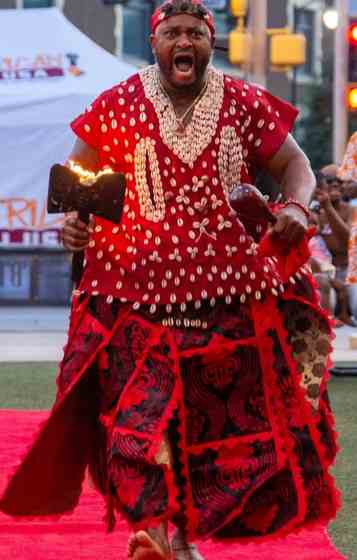 While he remains a symbol of power, justice, and authority, his representation in the diaspora is unique—blending Yoruba heritage with colonial histories, Catholic syncretism, and local folk practices. Understanding these representations offers insight into Yoruba spiritual identity and the creative ways in which sacred knowledge survives and thrives far from its place of origin.
Ṣàngó in Cuba: Changó and the Religion of Santería
In Cuba, Ṣàngó is widely known as Changó within the practice of Santería (also called Regla de Ocha). He is one of the most venerated Orishas, known for his fiery temperament, love of music, drumming, and dance.
Changó is often depicted holding the double-headed axe, showing his power and authority, much like in Yoruba tradition. However, his personality in Cuba emphasizes performance, public presence, and dramatic expression. Devotees dress in red and white during festivals and rituals, the colors symbolizing his energy, passion, and purity.
Cuban rituals often combine Yoruba-derived chants, drumming (batá drums), and Catholic elements, syncretizing Changó with St. Barbara, the Christian saint associated with lightning and fire. This blending allows followers to maintain a connection to their ancestral roots while navigating a colonial and post-colonial society. Changó in Cuba represents justice, courage, and leadership, but also creativity, dance, and communal joy. His festivals are highly performative, engaging the community and renewing social cohesion.
Ṣàngó in Brazil: Xangô in Candomblé and Umbanda
In Brazil, Ṣàngó is worshipped as Xangô in Candomblé and Umbanda. Here, he is celebrated not only as a deity of thunder and lightning but also as a symbol of kingship, law, and social order. Xangô is central to rituals involving fire, stones, and drumming, emphasizing both his destructive and protective powers. Like his Yoruba counterpart, he carries the double-headed axe, often held aloft during dances by initiated devotees, signifying authority, power, and fairness.
Brazilian representations of Xangô include elaborate costumes, red and white garments, and ceremonial objects that shows his royal and martial status. In Candomblé, he is frequently associated with justice and leadership, and devotees often call upon him to resolve disputes, correct injustices, and restore moral balance.
Wait a bit... Do you know that understanding the Orishas requires more than surface knowledge?
Get a structured and comprehensive eBooks on Orisha Osun, Orisha Oro, Orisha Sango, Orisha Ogun, Orisha Obatala, and Orisha Esu, covering how they are deified, rituals, taboos, festivals, oriki and more. Available individually or in bundles
Ṣàngó in the Caribbean: From Haiti to Trinidad
Across the Caribbean, Ṣàngó’s presence can be found in Vodou, Trinidadian Orisha practices, and folk traditions in Jamaica, the Dominican Republic, and Puerto Rico. He is often called Shango, preserving the original Yoruba pronunciation with minor adaptations.
In these contexts, Shango maintains his connection to thunder, lightning, fire, and authority, but local practices emphasize different aspects:
• In Haiti, Shango is present in Vodou ceremonies, often intertwined with lwa spirits of fire and justice. He embodies rapid transformation and decisive action.
• In Trinidad and Tobago, Orisha groups continue to perform ritual dances, drum patterns, and festivals in his honor. Shango is recognized for both martial strength and social guidance, preserving Yoruba musical and choreographic traditions.
• Across the Caribbean, Shango is associated with leadership, courage, protection of the community, and moral authority, reflecting the ethical framework of Yoruba cosmology despite geographical and cultural shifts.
These diaspora representations demonstrate zeal. Even in contexts where African religion was suppressed or hidden, Shango’s symbolism persisted through ritual, song, dance, and storytelling, maintaining continuity with the ancestral homeland.
Key Similarities and Differences Across the Diaspora
Across Cuba, Brazil, and the Caribbean, Ṣàngó retains essential characteristics:
• Authority and leadership
• Association with thunder, lightning, and fire
• Use of the double-headed axe as his symbol
• Connection to moral order and justice
Differences emerge in style, ritual emphasis, and syncretism:
1) Cuba emphasizes performance and Catholic syncretism with St. Barbara.
2) Brazil highlights ritual hierarchy, kingship, and justice, often blending with Catholic saints.
3) The Caribbean maintains martial energy, protection, and communal guidance, with ritual variations shaped by local history and environment.
Yoruba Herbs, Plants and Medicine Made Simple!
Spiritual knowledge is powerful—but when combined with herbal wisdom, it becomes complete. Check out Common Ailments and Their Natural Cures (preview here), Identification & Properties of Different Plants (see sample), Yoruba proverbs associated with different Herbs (see preview).
With these e-Books, you can treat illnesses naturally. Understand the proverbs behind plants/herbs. Identify plants, roots, barks with confidence.
Conclusion
Ṣàngó’s journey from Yorùbá land to the Americas is a foundation to the endurance of spiritual identity. Whether as Changó in Cuba, Xangô in Brazil, or Shango in the Caribbean, his essence as a deity of thunder, lightning, and justice has remained intact. Diaspora communities have adapted his worship to local circumstances, creating unique traditions that shows Yoruba philosophy, moral teaching, and cultural resilience.
Learn the general taboos of Orisha Oko in Yoruba c…

Check out the common items used in worshiping Oris…
CONNECT WITH US: