support@yorubalibrary.com
+2348073529208, 07038599574
Among all the Orisha in Yoruba thought, Ṣàngó has a remarkable place because his presence is recognized not only through stories, rituals, or shrines, but also through visible and audible forces of nature—thunder, lightning, and the electrifying energy that follows a storm. To the Yoruba, these natural events are not random occurrences. They are meaningful signs that point to the deep power, temperament, and authority of Ṣàngó as a king-figure and a spiritual force.
Thunder is understood as Ṣàngó’s authoritative voice, a reminder of his power to command, correct, and enforce justice. Lightning is seen as his direct strike, a symbol of precision, fire, and sudden transformation. Together, they are expressions of a force that cannot be ignored—a force that Yoruba people have respected, feared, and honored for centuries. Over time, these natural elements shaped how devotees understood leadership, discipline, law, and communal responsibility.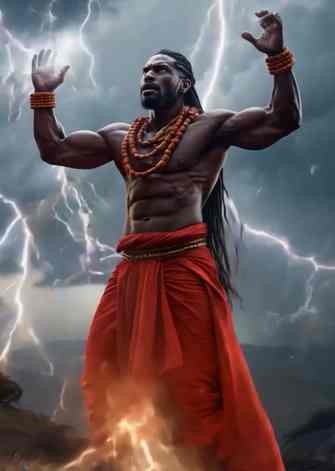 This write-up explains the relationship between Ṣàngó and these powerful natural elements, not from a shallow angle, but from a cultural, linguistic, philosophical, and symbolic viewpoint.
Thunder as the Audible Presence of Ṣàngó
To the Yoruba, thunder is not merely noise. It is the audible sign that Ṣàngó is aware of human actions. When thunder rumbles across the sky, many communities interpret it as his voice reminding people that wrongdoing, injustice, wickedness, or betrayal never truly goes unnoticed. Thunder carries the weight of authority; it echoes the power once held by Ṣàngó as a historical Alaafin who was known for discipline, order, and unshakeable command.
In traditional belief, the depth, intensity, and timing of thunder also carry meaning. A sudden loud roar during a serious communal issue may be taken as a spiritual commentary that calls for introspection or correction. This is because thunder is associated with Ṣàngó’s role as the enforcer of moral boundaries, the one who intervenes when humans exceed limits. Thunder therefore functions like a king's proclamation—firm, undeniable, and capable of restoring balance whenever it is needed.
Lightning as the Instrument of Ṣàngó’s Power
Lightning is understood as the sharp strike of Ṣàngó. It represents action, response, and divine clarity. While thunder may serve as the warning, lightning is the decision. It is direct, precise, and targeted.
When lightning touches the earth, and especially when it strikes a particular object or location, Yoruba elders interpret it through the lens of Ṣàngó’s sense of justice. Stories across Yoruba land tell of occasions when lightning hit places associated with falsehood, hidden wrongdoing, or secrets. These stories are not just mythic—they are moral instructions wrapped in observation of nature.
Because lightning is fast, bright, and impossible to resist, it shows Ṣàngó’s ability to cut through confusion and expose truth. Just as lightning reveals the sky for a moment, Ṣàngó exposes what is hidden, whether in personal behaviour or communal matters.
Lightning is also linked to his control over fire, energy, and transformation. Anything touched by lightning changes instantly, just as the presence of Ṣàngó is believed to alter situations without delay.
Wait a bit... Do you know that understanding the Orishas requires more than surface knowledge?
Get a structured and comprehensive eBooks on Orisha Osun, Orisha Oro, Orisha Sango, Orisha Ogun, Orisha Obatala, and Orisha Esu, covering how they are deified, rituals, taboos, festivals, oriki and more. Available individually or in bundles
Thunderstones (Edun Ara) as Evidence of Ṣàngó’s Authority
Within Yoruba communities, objects believed to be thunderstones—referred to as edun ara—are treated with reverence. These stones are traditionally believed to be the remains of Ṣàngó’s lightning strikes. They are not approached casually; they are touched or removed only after performing certain rituals or acknowledgments. These thunderstones are preserved by devotees because they symbolize:
• Ṣàngó’s visitation
• His acceptance of the land or household
• His support for justice or purity
• His protection from forces that threaten order
The presence of an edun ara in a family or shrine signifies a direct link with Ṣàngó’s power. They also serve educational roles: parents narrate stories about these stones to teach children about truthfulness, courage, and respect for divine authority.
The idea of thunderstones bridges nature and spirituality. It demonstrates how Yoruba people interpret natural phenomena as messages that reinforce social values.
Ṣàngó as the Embodiment of Fire, Authority, and Precision
Fire is central to understanding Ṣàngó, and lightning is one of the purest forms of natural fire. But beyond physical flame, fire represents strength, clarity, and uncompromising discipline. Ṣàngó’s association with lightning emphasizes:
• His quick response to disorder
• His intolerance for deceit
• His ability to bring sudden change
• His gift of energizing and inspiring courage
In Yoruba thought, the character of a leader is often compared to elements of nature. A strong leader must be decisive like lightning, firm like thunder, and brilliant like the flash that brightens the sky. Ṣàngó embodies this model of leadership, which is why thunder and lightning remain key attributes of his identity.
This connection also reinforces his symbolism as the Orisha of kingship, as the fire he wields reflects power that is both protective and corrective.
Yoruba Herbs, Plants and Medicine Made Simple!
Spiritual knowledge is powerful—but when combined with herbal wisdom, it becomes complete. Check out Common Ailments and Their Natural Cures (preview here), Identification & Properties of Different Plants (see sample), Yoruba proverbs associated with different Herbs (see preview).
With these e-Books, you can treat illnesses naturally. Understand the proverbs behind plants/herbs. Identify plants, roots, barks with confidence.
Cultural Practices and Observances Related to Storms
In many Yoruba communities, when a heavy thunderstorm begins, certain behaviours are observed. People may pause outdoor activities or ensure that sacred objects are covered or protected.
Some households say brief prayers acknowledging Ṣàngó’s presence. Others take a moment of silence, especially when thunder is extremely loud. These practices are not based on fear but on awareness and respect. Storms are moments when the boundary between the spiritual and natural seems thin.
Philosophical Meaning of Thunder and Lightning in Yoruba Thought
On a deeper level, thunder and lightning teach several moral and philosophical lessons:
1) Every action has consequences, just as lightning follows thunder.
2) Truth cannot stay hidden forever; lightning exposes even the darkest places.
3) Power must be used responsibly, because both thunder and lightning are awe-inspiring but can be destructive if misaligned.
4) Justice may be delayed, but it never disappears, much like thunder that arrives after the flash.
5) Leadership requires boldness, and boldness is reflected in the loudness of thunder and the brightness of lightning.
Learn the general taboos of Orisha Oko in Yoruba c…

Check out the common items used in worshiping Oris…
CONNECT WITH US: