support@yorubalibrary.com
+2348073529208, 07038599574
Colour in Yorùbá religion is never decorative. It communicates theology, authority, mood, and spiritual function. Each Òrìṣà is associated with specific colours that shows aspects of their character and domain. For Èsù, the dominant sacred colours are black and red. These are not random choices. They are deliberate symbols that depicts his position in the cosmic order.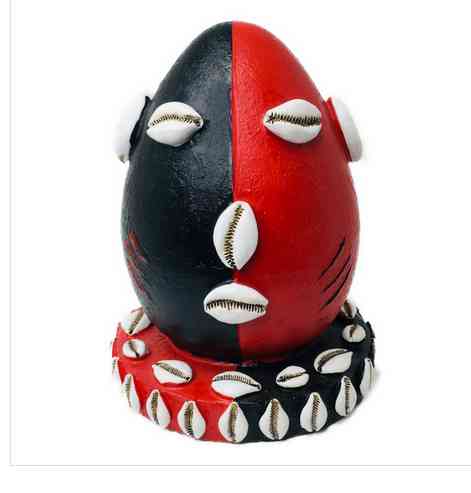 Many people who encounter Èsù imagery immediately notice the bold contrast of these two colours. Red may appear in cloth, beads, ritual powder, or palm oil offerings. Black may appear in stones, figurines, shrine painting, or ritual markings. Together, they form a visual code that speaks to his power, unpredictability, and balance.
To understand why Èsù chooses black and red, one must first understand his function in Yorùbá cosmology. Colour, in this context, is theology expressed visually.
Who Is Èsù?
Èsù is the divine messenger, guardian of crossroads, enforcer of sacrifice, and regulator of moral consequences. No ritual reaches any Òrìṣà without his acknowledgment. He ensures that offerings are delivered correctly and that actions produce appropriate results.
Èsù represents choice and consequence. He reveals truth by testing intention. He exposes hidden motives. Because his nature involves both reward and discipline, his colours must display duality, tension, and active force - Black and red do precisely that.
The Meaning of Red in Èsù’s personality
1. Red as Active Energy
In Yorùbá sacred understanding, red signifies vitality, movement, and intense force. It is the colour of heat, blood, and transformation. Èsù is never passive. He acts. He responds. He enforces. Red captures this active dimension of his character.
2. Red as Power and Authority
Red is often associated with spiritual potency (àṣẹ). Palm oil, which is central in many Èsù offerings, is red. Laterite stone (Yangí), frequently used in his shrines, also carries a reddish tone. These connections support red as a marker of sacred authority.
3. Red as Warning and Consequence
Red can also signal caution. Èsù governs consequence. When moral laws are ignored, results follow. The colour red communicates seriousness and accountability. It reminds devotees that actions matter.
Wait a bit... Do you know that understanding the Orishas requires more than surface knowledge?
Get a structured and comprehensive eBooks on Orisha Osun, Orisha Oro, Orisha Sango, Orisha Ogun, Orisha Obatala, and Orisha Esu, covering how they are deified, rituals, taboos, festivals, oriki and more. Available individually or in bundles
The Meaning of Black in Èsù’s Symbolism
1. Black as Mystery
Black represents what is hidden, unknown, or unseen. Èsù operates at boundaries—between visible and invisible realms. Much of his work happens beyond human perception. Black shows this mysterious dimension.
2. Black as Depth and Stability
Black also displays depth and grounding. It absorbs rather than reflects. Èsù listens. He receives sacrifices and prayers before transmitting them. Black expresses that receptive function.
3. Black as the Night and Crossroads
Crossroads, a major symbol of Èsù, often evoke twilight or darkness—moments of uncertainty when decisions must be made. Black aligns with these transitional states where direction is not yet fixed.
Why Black and Red Together?
The power of Èsù’s symbolism lies not just in each colour individually but in their combination.
1. Duality and Balance
Èsù governs opposites: reward and punishment, clarity and confusion, order and disruption. Red and black create a sharp contrast that visually expresses this balance of forces.
2. Action and Mystery
Red signifies visible action. Black signifies hidden processes. Together, they communicate that what is seen and unseen work together in producing outcomes.
3. Life and Boundary
Red relates to blood and vitality. Black relates to shadow and limit. Èsù stands at the boundary of life’s decisions. His colours exhibits tension.
Colours in Ritual Practice
In shrines dedicated to Èsù, red and black may appear in:
• Beaded necklaces (iléke)
• Cloth coverings
• Ritual markings
• Shrine painting
• Sacrificial items
When devotees wear red and black during ritual events, they are not making a fashion choice. They are joining themselves with the spiritual force and authority of Èsù. The colours serve as a visible declaration of association.
Yoruba Herbs, Plants and Medicine Made Simple!
Spiritual knowledge is powerful—but when combined with herbal wisdom, it becomes complete. Check out Common Ailments and Their Natural Cures (preview here), Identification & Properties of Different Plants (see sample), Yoruba proverbs associated with different Herbs (see preview).
With these e-Books, you can treat illnesses naturally. Understand the proverbs behind plants/herbs. Identify plants, roots, barks with confidence.
Correcting Misinterpretations
Colonial narratives often misread black and red as symbols of evil or danger. This interpretation ignores Yorùbá theological meaning. In traditional thought, colours are morally neutral; their significance depends on context.
Red does not mean violence. Black does not mean wickedness. Within Èsù’s framework, they represent energy, mystery, authority, and accountability. Understanding this distinction is important for accurate representation of Yorùbá religious heritage.
Conclusion
Black and red are not accidental selections for Èsù. Red represents vitality, action, authority, and consequence. Black represents mystery, depth, and the unseen dimension of spiritual law. Together, they communicate the dynamic balance that defines his character.
Learn the general taboos of Orisha Oko in Yoruba c…

Check out the common items used in worshiping Oris…
CONNECT WITH US: