support@yorubalibrary.com
+2348073529208, 07038599574
Among the many religious celebrations preserved within Yoruba tradition, the annual festival dedicated to Ọ̀ṣun stands as one of the most iconic. The festival is not simply a cultural gathering or public entertainment; it is a spiritual event that renews the covenant between the people and the river deity believed to protect and sustain the ancient town of Osogbo. Every year, thousands of devotees, traditional priests, pilgrims, scholars, and visitors gather to witness rituals that have been on-going for ages.
The preparation for this festival begins long before the main day of celebration. Weeks before the large procession to the river, sacred rites are performed quietly within shrines and palaces. These preparatory rites are essential because they cleanse the spiritual environment, confirm the readiness of the community, and invite the presence of the deity who is honored during the celebration. Among these preparatory events, one of the most significant is the ritual known as Iná Ojú Mẹ́rìndínlógún, which literally means the sacred fire of the sixteen-faced divination system.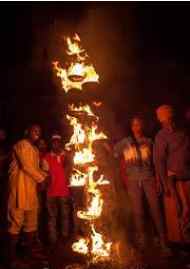 This ritual represents the moment when the spiritual authorities of the town formally open the period leading to the festival. Fire, within Yoruba ritual thought, represents illumination, revelation, and divine confirmation. When the fire associated with the sixteen sacred signs is invoked, it indicates that communication with the spiritual realm has begun. With this act, priests and diviners seek guidance from the unseen world to ensure that every aspect of the coming festival conforms with divine instruction.
The Osun Festival itself is strongly connected to the sacred landscape known as the Osun-Osogbo Sacred Grove, a forest sanctuary that houses shrines, sculptures, and ritual pathways dedicated to Ọ̀ṣun and other spiritual forces. The grove is not treated as an ordinary forest; it is regarded as a living shrine where nature and spirituality exist in close relationship. The annual festival therefore serves as both a religious ceremony and a re-affirmation of the town’s bond with the river that flows through the grove.
In the weeks leading to the festival, the town gradually shifts into a festival atmosphere. Traditional leaders, priests, priestesses, and palace officials begin coordinating activities that follow long-standing customs. Families who maintain hereditary roles within the festival prepare their ritual items, while shrines are cleaned and decorated. Sacred objects that remain hidden during most of the year are sometimes brought out and carefully arranged for the ceremonies ahead.
The role of divination becomes particularly important during this period. Yoruba spirituality places great emphasis on consulting divine wisdom before major events. Through the system known as Ifá Divination, priests seek guidance regarding the spiritual condition of the town and the requirements necessary for a successful celebration. The outcome of these consultations often determines the sacrifices, prayers, and ritual procedures that must be performed.
Within this framework, the ceremony of Iná Ojú Mẹ́rìndínlógún serves as a powerful spiritual readiness. The phrase Mẹ́rìndínlógún refers to sixteen, a number that carries specialty within Yoruba divination. The sixteen principal signs represent the foundation of sacred knowledge through which the divine communicates with humanity. Lighting the ritual fire connected to this system shows the activation of spiritual insight and the opening of communication between the community and the unseen realm.
The Meaning of Iná Ojú Mẹ́rìndínlógún
The phrase Iná Ojú Mẹ́rìndínlógún combines three important ideas in Yoruba ritual language. Iná means fire, ojú refers to the face or manifestation of a sign, and mẹ́rìndínlógún represents the number sixteen. Together, the phrase describes a ritual fire associated with the sixteen foundational signs used in Yoruba divination.
In Yoruba religious thought, the number sixteen has special importance because it forms the structural base of sacred knowledge. The sixteen principal signs generate the larger body of wisdom consulted by diviners. Lighting the ritual fire has something to do with these signs.
Wait a bit... Do you know that understanding the Orishas requires more than surface knowledge?
Get a structured and comprehensive eBooks on Orisha Osun, Orisha Oro, Orisha Sango, Orisha Ogun, Orisha Obatala, and Orisha Esu, covering how they are deified, rituals, taboos, festivals, oriki and more. Available individually or in bundles
Ritual Activities During the Preparatory Ceremony
The ceremony is conducted by traditional priests who possess the authority to oversee sacred rites connected to Ọ̀ṣun and the spiritual guardians of the town. Before the fire is lit, purification rites are performed within the shrine environment. These may include prayers, ritual washing, and the presentation of offerings.
Once the fire is lit, invocations are recited. These invocations acknowledge divine witnesses, ancestral spirits, and the protective forces believed to guard the community. The fire burns as a signal that the season leading to the festival has officially begun.
Community Preparation After the Ceremony
Following the ritual of Iná Ojú Mẹ́rìndínlógún, the wider community begins preparing for the days leading up to the festival. Shrines are repaired and decorated, traditional compounds organize offerings, and priests continue consultations through divination to confirm that all required rites are performed correctly.
Markets also become active during this period, as traders prepare materials needed for ritual offerings, festival attire, and ceremonial foods. The town gradually moves into an atmosphere of anticipation as both spiritual and social preparations materialized. At the palace level, traditional rulers and chiefs coordinate ceremonial responsibilities that must be fulfilled before the public celebration begins.
The Role of the Sacred Grove in Festival Preparation
Much of the spiritual activity connected to the festival centers around the sacred forest where the river flows. The grove houses numerous shrines and serves as the spiritual home of Ọ̀ṣun. Preparations within the grove include cleaning pathways, repairing shrines, and ensuring that ritual spaces are ready for the ceremonies that will take place during the festival. Priests also perform prayers within the grove to re-affirm the bond between the community and the river deity.
Yoruba Herbs, Plants and Medicine Made Simple!
Spiritual knowledge is powerful—but when combined with herbal wisdom, it becomes complete. Check out Common Ailments and Their Natural Cures (preview here), Identification & Properties of Different Plants (see sample), Yoruba proverbs associated with different Herbs (see preview).
With these e-Books, you can treat illnesses naturally. Understand the proverbs behind plants/herbs. Identify plants, roots, barks with confidence.
Importance of the Preparatory Rites
The ritual of Iná Ojú Mẹ́rìndínlógún demonstrates how Yoruba festivals combine spiritual consultation, community participation, and ancestral memory. Each step in the preparation supports the idea that major cultural events must be conducted with respect for divine instruction.
Conclusion
The preparation of the Osun Festival shows the depth and organization that characterize Yoruba religious celebrations. Far from being a simple public event, the festival emerges from a series of sacred rites designed to goes with the community by divine guidance. Among these rites, the ceremony known as Iná Ojú Mẹ́rìndínlógún plays a central role by opening communication between the human community and the spiritual realm.
Learn the general taboos of Orisha Oko in Yoruba c…

Check out the common items used in worshiping Oris…
CONNECT WITH US: