support@yorubalibrary.com
+2348073529208, 07038599574
How the worship of Orisha Oro began leave different curious to actually know that transpired. Oro stands in a category that is often misunderstood because it does not present itself in the same way as other Orisha. It has no widely displayed shrine in public squares, no sculpted image placed for daily veneration, and no open festivals that invite general participation. Yet its authority is felt, its presence widely acknowledged, and its influence is into the structure of traditional governance. This raises an important question: how did Oro begin, and how did it come to be regarded as an Orisha?
To answer this, one must first move away from the idea that all Orisha originated as single historical individuals who were later deified. While this is true for some, Yoruba spiritual development also includes forces that emerged from collective experience—institutions that became sacred because of the role they played in maintaining order and connecting the living with the ancestral realm. Oro belongs to this category.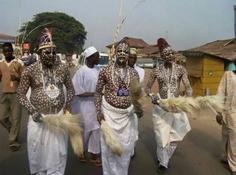 In early Yoruba society, the absence of centralized modern governance meant that communities relied on internal systems to regulate behavior and enforce laws. Elders, lineage heads, and spiritual specialists worked together to maintain balance. However, there was always a need for an authority that could operate beyond human bias—an authority that could not be easily challenged or manipulated. It is within this need that the basis of Oro can be understood.
At its earliest stage, Oro can be seen as an extension of ancestral reverence. The Yoruba worldview does not separate the living from the dead in absolute terms. Ancestors are believed to remain active, observing and influencing the affairs of their descendants. Over time, mechanisms were developed to communicate with these ancestral forces and to invoke their authority in matters of justice and communal discipline. Oro emerged as one of these mechanisms.
What distinguishes Oro from other forms of ancestral interaction is its structure. It is not a loose practice carried out by individuals; it is a regulated institution with defined roles, ranks, and procedures. This structure did not appear overnight. It evolved gradually, shaped by the needs of the community and refined through generations of practice. As it became more organized, it also became more powerful.
It is also important to note that Oro’s development was not isolated. It existed alongside other institutions such as kingship, lineage systems, and other Orisha traditions. Its role complemented these structures rather than replacing them. While kings ruled and priests performed rituals, Oro enforced boundaries and ensured compliance.
Wait a bit... Do you know that understanding the Orishas requires more than surface knowledge?
Get a structured and comprehensive eBooks on Orisha Osun, Orisha Oro, Orisha Sango, Orisha Ogun, Orisha Obatala, and Orisha Esu, covering how they are deified, rituals, taboos, festivals, oriki and more. Available individually or in bundles
Early Foundations: Ancestral Presence
The earliest roots of Oro can be traced to the Yoruba belief in the active presence of ancestors. In traditional thought, the dead do not disappear; they transition into a state where they continue to influence the living. This belief created a framework in which the authority of ancestors could be invoked to regulate behavior.
Communities developed ways to channel this authority. Rituals, chants, and designated spaces allowed for communication with ancestral forces. Over time, these practices became more structured, leading to the emergence of institutions that specialized in managing this relationship.
Orisha Oro can be seen as one of these institutions—a system that harnessed ancestral authority and applied it to communal governance. Its early function was not centered on worship in the conventional sense but on enforcement and regulation.
From Practice to Institution
As Yoruba communities grew in complexity, informal practices were no longer sufficient to maintain order. There was a need for organized systems that could operate consistently across different situations.
This led to the formalization of Oro. Roles were defined, hierarchies established, and procedures standardized. Individuals were initiated into the system, trained in its operations, and entrusted with its responsibilities. The transformation from practice to institution marked a significant stage in the development of Orisha Oro. It was no longer just a method of invoking ancestral authority; it became a structured body with its own identity.
The Emergence of Secrecy and Restricted Knowledge
One of the defining features of Oro is its secrecy. This was not present in its earliest forms but developed as the institution became more complex. Secrecy served several purposes. It protected the knowledge associated with Oro from misuse, ensured that only trained individuals could access its deeper aspects, and cements the authority of those within the system.
As secrecy increased, so did the perception of Oro as something beyond ordinary understanding. This contributed to its gradual elevation from a functional institution to a robust one.
The Role of Sound in Shaping Identity
The association of Oro with a distinctive sound played a crucial role in its development. This sound became the primary means through which Oro made its presence known.
Unlike other forms of spiritual expression that rely on visual symbols, Oro’s identity became tied to what could be heard but not seen. This absence of visible form added to its mystique from ordinary experience. The sound also served practical purposes. It allowed Oro to communicate across distances, announce its presence, and enforce restrictions without requiring physical visibility.
Recognition as a Sacred Force
The process of deification is not a single event but a gradual shift in perception. As Oro continued to demonstrate its effectiveness in maintaining order, it began to be regarded as more than a human institution.
Its decisions were seen as carrying the weight of ancestral authority. Its presence was treated with reverence. Its rituals were conducted with a level of seriousness reserved for sacred practices.
Yoruba Herbs, Plants and Medicine Made Simple!
Spiritual knowledge is powerful—but when combined with herbal wisdom, it becomes complete. Check out Common Ailments and Their Natural Cures (preview here), Identification & Properties of Different Plants (see sample), Yoruba proverbs associated with different Herbs (see preview).
With these e-Books, you can treat illnesses naturally. Understand the proverbs behind plants/herbs. Identify plants, roots, barks with confidence.
Integration into Yoruba Governance
Orisha Oro did not exist in isolation; it became an integral part of traditional governance. Kings, chiefs, and other authorities operated alongside it, each with defined roles.
While political leaders handled administrative matters, Orisha Oro provided a form of enforcement that was perceived as impartial and beyond human bias. This made it a valuable component of the system. Its integration into governance further strengthened its status. It was no longer just a spiritual practice; it was a pillar of societal structure.
The Continuity
The survival of Orisha Oro over time is due to its ability to adapt while maintaining its core principles. Knowledge is passed through world of mouth and training.
This continuity ensures that the Orisha Oro clans do not lose its identity. Even as external conditions change, the internal structure remains intact. The role of custodians—those who hold and transmit knowledge—is crucial in this process. They ensure that the practices associated with Oro are preserved accurately.
Oro in Contemporary Context
In modern times, the perception of Oro varies. In some communities, it is a central institution, while in others, its influence has diminished due to social and religious changes. However, where it continues to exist, it retains its core functions. It still represents authority, secrecy, and the connection to ancestral forces.
Learn the general taboos of Orisha Oko in Yoruba c…

Check out the common items used in worshiping Oris…
CONNECT WITH US: