support@yorubalibrary.com
+2348073529208, 07038599574
One Yoruba proverb says "Ohun ti Ara Egungun gba, Ara Oro ko gba a..." (What Egungun likes is certainly a dislike for Oro...). This proverb, even though show some correlations between the two Ancestral deities, yet stylishly tells us they still have difference.
Within Yoruba spiritual life, few institutions command as much recognition as Egúngún and Oro. Both are tied to ancestral presence, both operate within structured traditions, and both exert authority over the community in ways that go beyond ordinary human systems. Yet despite these similarities, they are not interchangeable. Confusing them leads to serious misunderstanding of how Yoruba cosmology organizes power, identity, and communication with the unseen.
At a surface level, the connection between Egúngún and Oro appears obvious. Both are associated with the ancestors. Both emerge during specific periods with noticeable impact on the community. Both command respect, enforce discipline, and operate through forms that are not entirely accessible to outsiders. To someone unfamiliar with their internal logic, they may seem like two versions of the same phenomenon. But this assumption quickly breaks down when examined closely.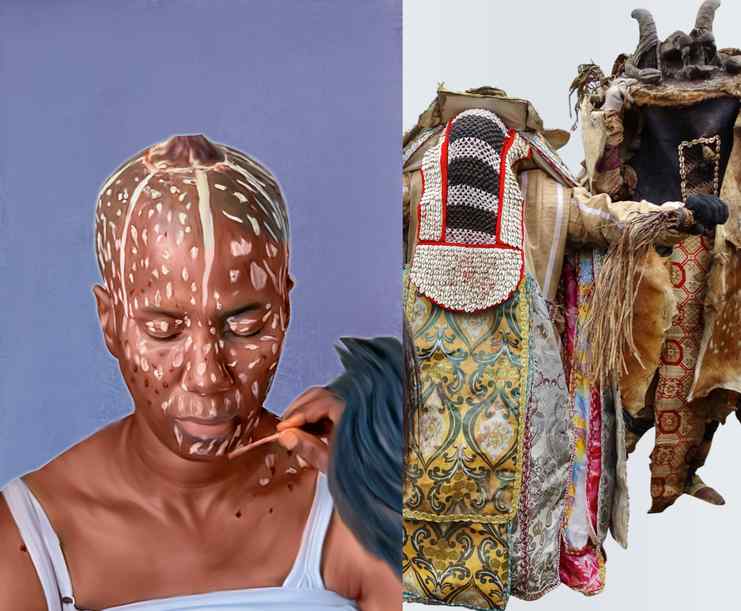 The Yoruba worldview does not treat all ancestral manifestations as identical. There are categories, functions, and methods through which the ancestors engage the living. Egúngún represents one mode of ancestral return—visible, and often interactive. Oro represents another—hidden, disembodied, and controlled through sound and restriction. These differences are not accidental; they shows deliberate structuring within the culture.
Historically, both institutions developed to address different needs within society. While Egúngún provides a way for ancestors to appear, bless, warn, and sometimes entertain, Oro serves as an enforcer of order, operating through fear, discipline, and controlled authority. One engages the community openly (within limits), while the other withdraws from open visibility to maintain its power.
It is also important to recognize that participation differs significantly between the two. Egúngún festivals often involve broader community engagement, including women and children as spectators. Oro, on the other hand, is marked by restriction—particularly in who can see, hear, or even be present during its exhibition. This distinction alone signals that they occupy different roles despite sharing a common foundation.
In many Yoruba towns, both institutions coexist, each maintaining its own structure, leadership, and sacred spaces. Their coexistence does not create conflict because their functions are clearly defined. Instead, they complement one another, forming a balanced system where visibility and invisibility, openness and secrecy, interaction and restriction all have their place.
Wait a bit... Do you know that understanding the Orishas requires more than surface knowledge?
Get a structured and comprehensive eBooks on Orisha Osun, Orisha Oro, Orisha Sango, Orisha Ogun, Orisha Obatala, and Orisha Esu, covering how they are deified, rituals, taboos, festivals, oriki and more. Available individually or in bundles
Shared Similarities among the deities
At their core, both Egúngún and Oro are based in the Yoruba belief that the ancestors remain active in the affairs of the living. The dead are not considered gone; they exist in another state and can be called upon, honored, or invoked.
Egúngún represents ancestors returning in a form that can be seen. The masquerade embodies the spirit, allowing it to interact with the community. Oro, on the other hand, represents ancestral authority in a less direct form—one that is heard rather than seen.
Visibility vs. Invisibility
The most obvious difference between Egúngún and Oro lies in how they are showcased. Egúngún is visible. It appears in elaborate costumes, often covering the entire body, with layers of fabric that conceal the human underneath. The visual presence is central to its function. People gather to watch, to receive blessings, and sometimes to be corrected or warned.
Oro, by contrast, is deliberately invisible. Its presence is made known through sound, not form. There is no public display, no costume presented for general viewing. This absence of visibility is not a limitation; it is a feature that that affirms what Orisha Oro stands for.
Participation and Gender Roles
Participation in Egúngún activities is relatively inclusive. While certain roles are restricted to initiated individuals, the general public—including women—can witness and engage with the event from a distance. Festivals often become communal gatherings where different segments of society are present.
Oro operates under stricter rules. In many communities, women are prohibited from seeing Oro or being present during its manifestation. Movement may be restricted, and specific instructions must be followed without question. This difference highlights the contrasting nature of the two clans.
Function: Celebration vs. Enforcement
Egúngún serves multiple functions, including remembrance, blessing, moral instruction, and social cohesion. While it can enforce discipline, it often does so within a context that includes celebration and public engagement.
Oro is more closely associated with enforcement. Its primary role is to regulate behavior, enforce laws, and maintain order. The atmosphere surrounding Oro is more serious, with less emphasis on celebration and more on authority.
Public Spaces and Movement
Egúngún operates in public spaces—streets, marketplaces, and designated areas where people can gather. Its movement is visible and often dynamic, covering different parts of the community.
Oro is tied to restricted spaces, particularly the sacred forest known as Igbo Oro. Its activities are not meant for public observation, and its movement is often followed by restrictions on others.
Yoruba Herbs, Plants and Medicine Made Simple!
Spiritual knowledge is powerful—but when combined with herbal wisdom, it becomes complete. Check out Common Ailments and Their Natural Cures (preview here), Identification & Properties of Different Plants (see sample), Yoruba proverbs associated with different Herbs (see preview).
With these e-Books, you can treat illnesses naturally. Understand the proverbs behind plants/herbs. Identify plants, roots, barks with confidence.
Secrecy and Knowledge Structure
While both institutions contain elements of secrecy, the degree and function differ. Egúngún has hidden aspects, particularly regarding the identity of the person inside the costume and certain ritual procedures. However, much of its activity is visible and shared with the community.
Oro is built on a much complex level of secrecy. Knowledge is tightly controlled, and access is restricted through initiation. The power of Oro depends heavily on what is not revealed.
Authority and Emotional Response
Egúngún can evoke excitement, reverence, and even joy, alongside respect. Its presence is often anticipated and welcomed during festivals. Oro evokes a more restrained response—respect mixed with caution. Its appearance signals a shift in behavior, often requiring silence, withdrawal, or compliance.
Recognizing both the similarities and differences between Egúngún and Oro is essential for a proper understanding of Yoruba culture. It prevents oversimplification and respects the complexity of the systems involved.
Learn the general taboos of Orisha Oko in Yoruba c…

Check out the common items used in worshiping Oris…
CONNECT WITH US: