support@yorubalibrary.com
+2348073529208, 07038599574
Within Yoruba cosmology, the unseen world is not a distant abstraction—it is actively present, structured, to human life. Two of the most significant manifestations of this unseen reality are Orisha Oro and the Egungun tradition. While both relate to forces beyond the ordinary human experience, they represent two distinct aspects of spiritual authority and cultural memory.
Orisha Oro is often associated with the forest, secrecy, and the enforcement of discipline. It operates through controlled access, restricted knowledge, and a system that emphasizes authority through sound, presence, and ritual silence. Its presence is not meant to be visually engaging or publicly displayed; instead, it is felt through its sound and the structure of its rules.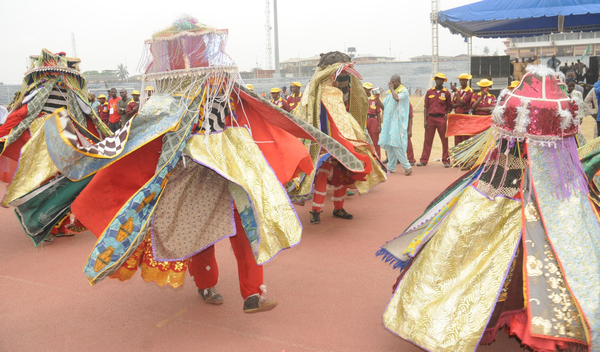 In contrast, the Egungun tradition is centered on ancestral veneration. It brings the memory of the departed into the visible world through masquerade, performance, and communal celebration. Unlike Oro, which emphasizes concealment, Egungun emphasizes revelation—allowing the community to witness the presence of ancestors through elaborate costumes and public display.
At first glance, these two systems may appear similar because both deal with spiritual forces that are not always visible in everyday life. However, their roles, methods, and meanings are fundamentally different. One represents authority through secrecy and control, while the other represents continuity through memory and expression.
Orisha Oro: The Spirit of Authority and Control
Orisha Oro is deeply associated with the forest, known in Yoruba as Igbo Oro. This is not just a physical space but a sacred environment where Oro is believed to reside and operate. The forest represents depth, secrecy, and separation from ordinary life.
Oro is primarily concerned with discipline, order, and enforcement. Its presence is often marked by its distinct sound, which serves as both a warning and a command. When Oro is active, the community is expected to observe strict silence and follow specific rules.
Wait a bit... Do you know that understanding the Orishas requires more than surface knowledge?
Get a structured and comprehensive eBooks on Orisha Osun, Orisha Oro, Orisha Sango, Orisha Ogun, Orisha Obatala, and Orisha Esu, covering how they are deified, rituals, taboos, festivals, oriki and more. Available individually or in bundles
Egungun: The Living Presence of Ancestors
The Egungun tradition represents a completely different dimension of Yoruba spirituality. It focuses on the ancestors—those who have lived, contributed to the community, and transitioned into the spiritual realm.
Egungun is most often experienced in public settings, where masked performers represent ancestral spirits. These performers are covered in elaborate costumes made of layered fabrics, designed to conceal their identity while allowing them to embody the presence of the ancestors.
The Egungun appearance is not just visual—it is performative. The movement, dance, and interaction with the audience all contribute to the experience. Through Egungun, ancestors are not just remembered; they are actively present and engaged with the community.
One of the key functions of Egungun is to provide guidance, blessings, and sometimes warnings from the ancestral realm. It acts as a bridge between the living and the dead, reinforcing continuity across generations.
Unlike Oro, which restricts access, Egungun invites participation. The community gathers to witness, celebrate, and interact with the ancestral presence.
Sound vs. Performance: Different Modes of Expression
Another important distinction is the way each tradition communicates.
• Oro communicates through sound
• Egungun communicates through performance
The sound associated with Oro is deep, continuous, and often described as commanding. It signals presence and enforces silence. It does not invite interaction; it demands response.
Egungun, however, uses dance, movement, and visual expression. It interacts with the audience, often engaging directly with individuals in the community. It is dynamic, expressive, and interactive.
While Oro’s sound creates an atmosphere of control, Egungun’s performance creates an atmosphere of celebration and connection.
Authority vs. Ancestral Memory
Oro and Egungun also differ in their core purpose.
• Oro represents authority and regulation
• Egungun represents memory and continuity
Oro is often associated with maintaining order, enforcing rules, and ensuring discipline. It is a system that supports governance and social structure.
Egungun, on the other hand, focuses on honoring those who came before. It preserves memory, celebrates lineage, and reinforces the idea that the living are connected to their ancestors. Together, they represent two essential aspects of society: order and continuity.
Yoruba Herbs, Plants and Medicine Made Simple!
Spiritual knowledge is powerful—but when combined with herbal wisdom, it becomes complete. Check out Common Ailments and Their Natural Cures (preview here), Identification & Properties of Different Plants (see sample), Yoruba proverbs associated with different Herbs (see preview).
With these e-Books, you can treat illnesses naturally. Understand the proverbs behind plants/herbs. Identify plants, roots, barks with confidence.
Participation and Access
Access to Oro and Egungun is structured differently. Oro is restricted. Only certain individuals, typically initiates, are allowed to participate directly in its rituals. The wider community may experience its presence indirectly, but not through full participation.
Egungun is more inclusive. The community is often invited to participate in celebrations, witness performances, and engage with the ancestral representation. This difference reflects their roles. Oro maintains boundaries, while Egungun builds connections.
Complementary Forces in Yoruba Cosmology
Rather than viewing Oro and Egungun as opposing forces, it is more accurate to see them as complementary.
1) Oro ensures that the community adheres to rules and maintains order
2) Egungun ensures that the community remembers its origins and honors its past
Conclusion:
Orisha Oro and the Egungun tradition represent two distinct yet interconnected aspects of Yoruba spirituality. One operates through secrecy, sound, and authority, while the other operates through visibility, performance, and ancestral remembrance.
Learn the general taboos of Orisha Oko in Yoruba c…

Check out the common items used in worshiping Oris…
CONNECT WITH US: