support@yorubalibrary.com
+2348073529208, 07038599574
Within Yoruba religious practice, sacrifice is neither random nor in a shallow sense. Every sacrificial item corresponds to the nature, temperament, and historical memory of the divinity receiving it. In the worship of Ogun, the offering of a dog (Aja) stands out as one of the most discussed and, at times, misunderstood ritual acts. To outsiders, it may appear harsh or arbitrary. Within Yoruba cosmology, however, it lies in myth, character symbolism, and theological logic.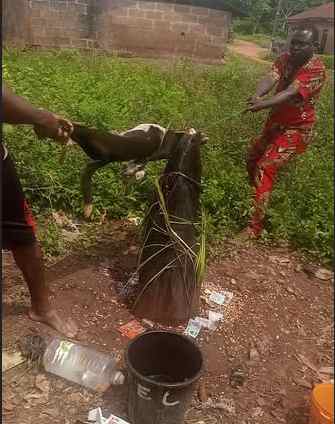 Ogun is not merely the deity of iron; he embodies force, discipline, war, craftsmanship, oath-taking, and uncompromising truth. His temperament in oral tradition is intense and direct. Sacrificial practice in his worship shows these traits. The dog, as an offering, go inline with Ogun’s identity in ways that extend beyond normal preference. It is associated with loyalty, vigilance, aggression when necessary, and companionship in hunting and warfare.
Understanding why the dog became strongly associated with Ogun requires attention to mythological narratives, social structure in precolonial Yoruba society, and the reading of animal behavior. The connection is not accidental. It depicts a worldview in which spiritual identity and natural characteristics mirror one another.
Mythological Foundations of the Dog in Ogun’s Narrative
In Yoruba oral tradition, Ogun is often portrayed as a primordial hunter and path opener. Before cities were established, before farmland was cleared on a large scale, he is said to have cut through thick forest to create habitable routes. In this early wilderness setting, the dog was the hunter’s closest companion. It assisted in tracking, guarding camps, and confronting wild animals.
Some traditions recount that during moments of intense battle or sacrifice, Ogun himself accepted the dog as a fitting offering because it represented the very qualities he values: courage, endurance, and unwavering loyalty. The animal’s readiness to confront danger shows Ogun’s own fearless disposition.
There are also accounts in certain Yoruba communities that suggest the dog accompanied Ogun during his earthly reign as a warrior-king before his deification. In these narratives, the bond between hunter and dog becomes ritualized in divine memory. The sacrificial offering therefore recalls a primordial partnership between iron and animal strength.
The Dog and Ogun’s Temperament
The dog in Yoruba culture is known for vigilance, territorial protection, loyalty to its master, and ferocity when threatened. These characteristics parallel Ogun’s theological profile. Ogun is guardian of oaths and punisher of falsehood. He is invoked when serious promises are made. His enforcement is believed to be swift and decisive.
The dog’s alertness and intolerance for intrusion go alongside with Ogun’s role as protector of boundaries. In ritual thought, offering a dog shows presenting to Ogun an animal that depicts his own personality traits. The sacrifice is therefore not about preference in a simplistic sense but about symbolic congruence.
Wait a bit... Do you know that understanding the Orishas requires more than surface knowledge?
Get a structured and comprehensive eBooks on Orisha Osun, Orisha Oro, Orisha Sango, Orisha Ogun, Orisha Obatala, and Orisha Esu, covering how they are deified, rituals, taboos, festivals, oriki and more. Available individually or in bundles
Sacrifice as Covenant and Spiritual Exchange
In Yoruba metaphysics, sacrifice establishes relationship and covenant. The offering is not viewed as feeding a deity in a literal biological sense. Instead, it represents an exchange that reinforces spiritual alliance. For Ogun devotees, the dog sacrifice serve as a seriousness of commitment.
Because Ogun is regarded as intolerant of deceit, sacrifices to him often accompany oath-taking, warfare preparation, or communal protection rituals. The offering of a dog signifies gravity and sincerity. It communicates that the devotee approaches Ogun with full recognition of his demanding nature.
Historically, warriors and blacksmiths may have offered dogs during periods of conflict or before embarking on dangerous missions. The act served as invocation of strength and alignment with Ogun’s forceful energy. The sacrificial blood symbolized activation of iron’s spiritual potency.
Regional Variations and Historical Transformation
It is important to acknowledge that sacrificial practices vary across Yoruba regions and historical periods. Not all communities maintain identical ritual emphasis. In some modern contexts, or alternative offerings are used due to legal, social, or ethical shifts.
Urbanization, colonial influence, and contemporary religious change have altered how Ogun worship is practiced. While the historical association between Ogun and the dog remains well documented in oral tradition and ethnographic accounts, present-day practice may differ significantly depending on location and practitioner.
Scholarly documentation from nineteenth and twentieth-century observers of Yoruba religion consistently noted the prominence of dog sacrifice in Ogun rites. However, Yoruba religion is dynamic, and adaptation over time reflects broader societal transformation.
Yoruba Herbs, Plants and Medicine Made Simple!
Spiritual knowledge is powerful—but when combined with herbal wisdom, it becomes complete. Check out Common Ailments and Their Natural Cures (preview here), Identification & Properties of Different Plants (see sample), Yoruba proverbs associated with different Herbs (see preview).
With these e-Books, you can treat illnesses naturally. Understand the proverbs behind plants/herbs. Identify plants, roots, barks with confidence.
Ethical and Cultural Interpretation
Modern readers often encounter discomfort when discussing animal sacrifice. It is essential to situate the practice within its indigenous philosophical framework. In precolonial Yoruba thought, animals used in sacrifice were part of a broader system of ritual economy in which life, death, and offering were integrated into cosmological order.
The dog’s association with Ogun does not imply casual violence. It shows a structured ritual code governed by priests, taboos, and ceremonial law. The act was regulated, purposeful, and spiritually contextualized.
Conclusion
The relationship of dog with Ogun lies in mythic memory, symbolic alignment, hunting culture, martial identity, and covenant theology. The dog embodies vigilance, courage, loyalty, and protective aggression — traits that mirror Ogun’s character as guardian of iron and enforcer of truth. The sacrificial practice historically functioned as a serious spiritual exchange rather than a random act.
Learn the general taboos of Orisha Oko in Yoruba c…

Check out the common items used in worshiping Oris…
CONNECT WITH US: